

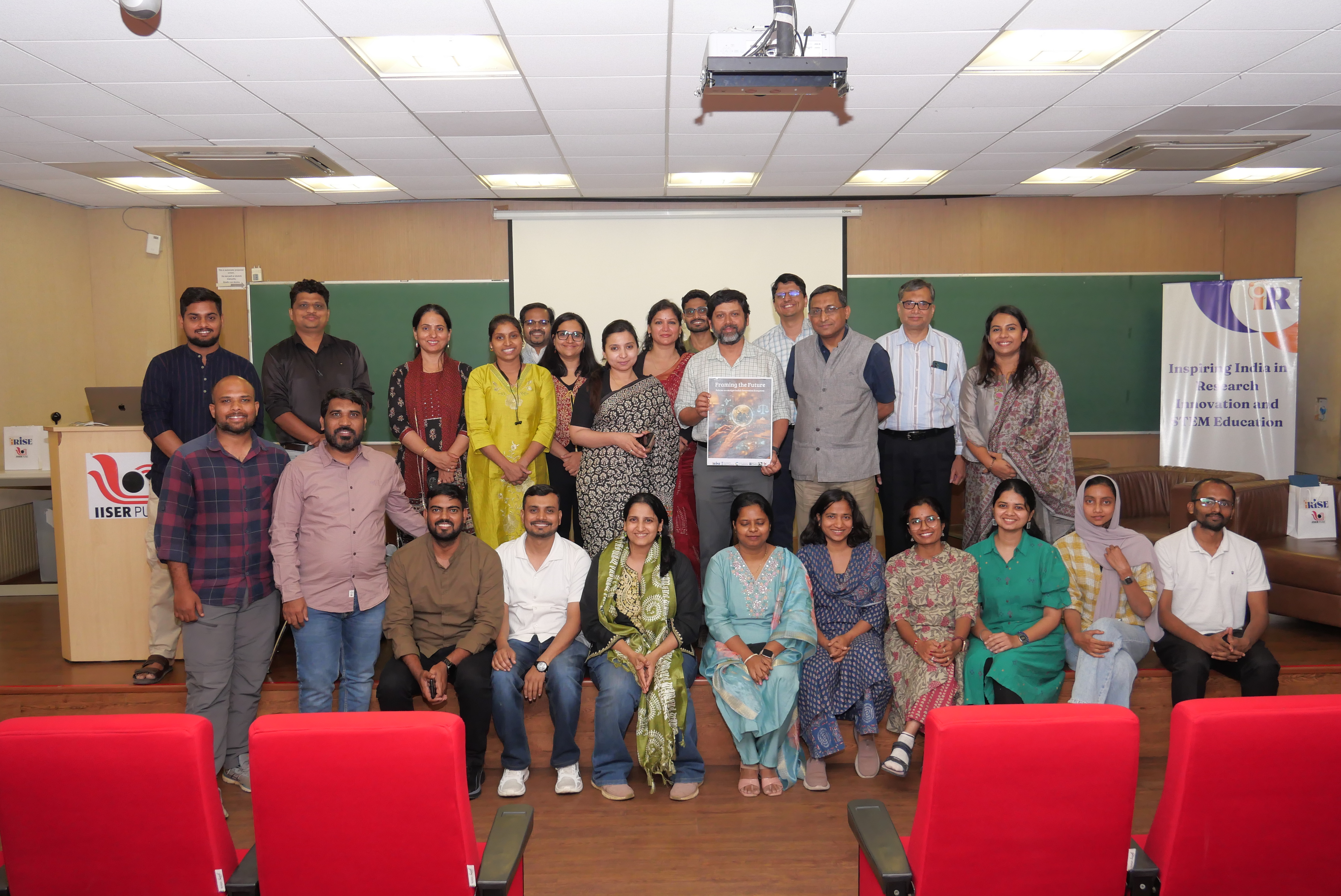
On the eve of National Science Day, the TLF Strand marked the occasion with the launch of a landmark collection of essays titled: ‘Framing the future: Policies to catalyse India’s Innovation Ecosystem’. The essays focus on the role of chemistry as an enabling infrastructure for national development. The publication addresses a key question: how should India govern chemistry-driven innovation in an age of disruption? The book brings together diverse perspectives spanning public health, climate action, advanced manufacturing, biomedicine, and deep-tech entrepreneurship.
The book was formally unveiled in the presence of three contributing authors Prof. Shobha Shukla (IIT Bombay), Ms. Amrutha C (Sree Chitra Tirunal Institute for Medical Sciences and Technology – SCTIMST), and Dr. Swetavalli Raghavan (Royal Society of Chemistry) along with the Director of IISER Pune, Prof. Sunil Bhagwat. Their presence added valuable academic, policy, and institutional perspectives to the launch.
The essays highlight how advances in chemistry underpin critical sectors such as clean energy, sustainable materials, catalysis, disease surveillance, and next-generation therapeutics, positioning the discipline as a foundational driver of technological progress and societal well-being.
A panel discussion on science, innovation, and policy in India was also an integral part of the event. The discussion featured Prof. Avinash Kumbhar (CEO, Pune Knowledge Cluster) and Dr. Premnath (Venture Centre, CSIR-NCL, Pune), along with the authors of the book, who shared insights on the current state of India’s innovation ecosystem, the importance of translational research, and the need for stronger connections between academia, industry, and policy. The discussion was highly engaging, with active audience participation that made the session interactive and thought-provoking.
The event also emphasised the importance of anticipatory governance by developing policy frameworks that evolve alongside scientific innovation. Discussions highlighted the need for agile and forward-looking policies that support not only fundamental research but also the translation of discoveries from molecules to markets. Particular emphasis was placed on strengthening innovation pathways, fostering academia–industry partnerships, and creating regulatory environments that encourage responsible and scalable innovation.
The event concluded with reflections on how coordinated efforts across science, policy, and entrepreneurship can help build a resilient and future-ready innovation ecosystem, with chemistry playing a central and enabling role.
Copyright 2026 iRISE.